
Please follow and like us:


 |
| Image via Flickr Creative Commons (Caleb Roenigk) |
 |
| Originally posted to Flickr |
On the bus last week, I was standing behind someone typing on a tablet. She was using the on-screen touchpad keyboard. Not that I was spying or anything (honest!), I watched how she typed an accented é: she touched the e “key” for an slightly extended time—less than a second—until a menu of accented characters appeared on the screen above the keypad, then slid her finger to her choice.
Seeing it in action started me thinking: is on-screen typing, as done on touch-screen computers, changing the way we write?
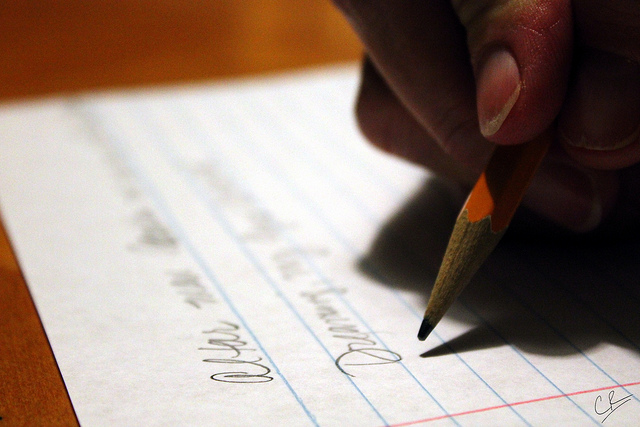
We all learn to write, or print, with a stylus directly marking a surface: pencil on paper, crayon on colouring book, brush on parchment.
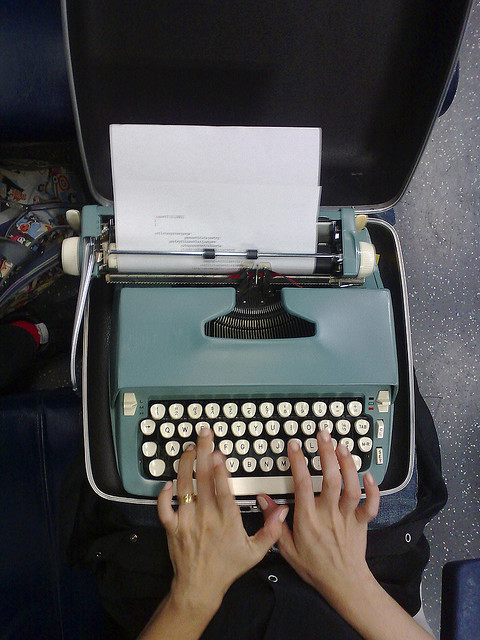
Since the invention of the typewriter in the 1860s, the technology of writing has been a kind of remote control, separating the action of our fingers from the results. Press a key on a typewriter, and the attached type bar strikes the ribbon and impresses it onto the paper.
Since then, typing technological development has progressively increased the distance between actions and results. To create this post, I am tapping my fingers on a wireless keyboard. I can’t imagine how many digital transformations occur to make the characters I am typing appear on the screen in front of my eyes. It’s only after I hit the Print button that the printer, two metres from the keyboard, puts marks on paper.
But I won’t print this particular essay. I’ll edit and proofread it on-screen, and then post it on this blog, hosted on a server hundreds or thousands of kilometres from this screen and keyboard. Or maybe it’s next door—I have no way of knowing.
 |
| Image via Flickr Creative Commons (Stan Wiechers) |
Closing the gap between action and consequence
Typing on a touch screen brings actions closer to results. There is still a separation, of course, as the keypad is at the bottom of the screen and the words may be at the top, but still, it’s closer than the typewriter allowed.
Standing on the bus in rush hour, I was fascinated by the woman typing on the touch-screen. I wondered: is her writing experience different?
Personally, I don’t like typing on a touch screen. There is no physical or kinetic feedback from a touch screen, unlike with a keyboard, where I can feel the key depress and spring back.
Also, using the touch pad on my iPad shrinks the display of the writing I’m doing. I like to be able to see the words I’ve written. So I have a Bluetooth keyboard to write with my iPad, re-establishing that remote action of the old-fashioned typewriter.
An area to research
Does bringing the result, the mark on the writing surface, closer to the motion of our fingers make typing on a touch screen closer to writing with a pencil on paper?
And if it does, will that have an effect on the way that we write? Will it affect the words we choose, the way we construct phrases and sentences?
Will we be able to tell a book written on a touch-screen from a book created with a typewriter?
I can imagine someone getting a doctoral degree on this by analyzing documents written with a stylus on paper with those created on a computer using a standard word processor, and others written using a touch screen. And I’d be fascinated to see the results.
What do you think? If you use a touch screen for anything, do you find the writing experience different? Do you like typing on a touch screen?
Do you think that the touch screen changes the way you write?