


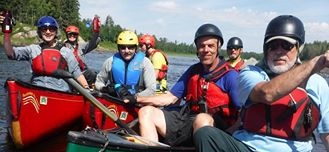
But I have to admit I came close to losing my cool a couple of times
If you’ve missed me on social media since July 30, here’s why: I’ve been literally hundreds of miles from Internet access. Besides being the most physically challenging thing I have ever done, this “vacation” made me rediscover some things about writing.
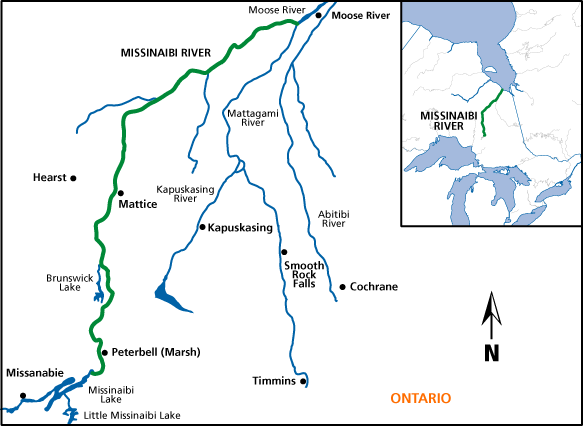
Over the past two weeks, I joined my younger son, Super Nicolas and eight other people to paddle the Missinaibi River in northern Ontario to the Moose River, and then down it to Moose Factory and Moosonee on James Bay. It was 11 days of paddling eight to ten hours a day. On some days, we paddled over 50 kilometres to reach our next camp site. Other days, we faced portages up to three kilometres long.
We began our paddling journey at Mattice, a tiny village mostly remarkable for being the point where the Missinaibi River crosses Ontario Highway 11. (That’s the same highway that begins at the Toronto waterfront as Yonge Street.) We paddled white-water canoes 325 kilometres from there to Moose Factory, near where the Moose River empties into James Bay. Moose Factory is the site of the oldest Hudson’s Bay Company establishment, or “factory” where the company transferred its traded furs from ships to canoes that ranged inland on Canada’s network of rivers, including the Missinaibi, Abitibi and Mattagami, portaging overland to other river systems that brought all of North America in reach.
From Moose Factory, we paddled across the river to the newer town of Moosonee. At its train station, we loaded our canoes, gear and ourselves onto the Polar Bear Express, a train operated by Ontario Northland Railway. We rode back to Cochrane, Ontario, where we had left one car as a shuttle to get the others in Mattice.
Eagles every day
There are so many remarkable things about paddling through northern Ontario, it’s hard to know where to start. There’s the beauty of the landscape, first of all.
Mattice is on the Canadian Shield, the geography where I grew up. The journey to putting in the canoes felt a little like coming home.
The Shield is a rocky place, mostly low, rolling hills with many outcroppings of bare rock and cliffs, covered with spruce and fir trees, dotted with thousands of lakes and marshes. It carries a huge feeling of wildness. Once we left Mattice, we did not come within hundreds of kilometres of any human civilization until Moose Factory.
This landscape is as wild as wild gets. We carried in our own food, supplemented by fish that one of the members of our team, Gil Lepine, caught nearly every day. We also carried out all our garbage as we believe in no-trace camping. We camped on the shore of the river, several times on beaches, and dealt with the mosquitoes, black flies, horse flies and deer flies as best we could.
We saw at least one bald eagle every day, along with loons, geese and other birds. Except for squirrels, we not see much other wildlife — no sign of bears, deer or moose. I did see some wolf footprints on one beach, and took photos of it. Unfortunately, on the second-last day of the trip, I knocked my waterproof camera out of the canoe into the Moose River. Any pictures are contributed by others in my group. Alas.
Far, far away from the Internet
 Our only means of communications with the outside world were a SPOT geo-locator, which we activated once a day. It communicated our longitude and latitude to a satellite, which then sent emails saying “we’re okay” along with our coordinates to our loved ones in civilization. We also had a satellite phone for emergencies.
The only way I can say I missed the Internet was any kind of automatic uploading of my photos to the cloud.
Along the way, I’d sometimes think about how I would post all my pictures to Facebook and create a photo essay for this blog. Alas, again.
I recorded some of my thoughts and impressions on paper in a notebook, as did Nicolas. We each plan to work those notes up into some kind of story about the journey. But to tell the truth, I’ll have to rely on memory more than on notes. Each night, I was too tired to write more than a few words.
When we returned, one of the members asked “I wonder how many stupid things Donald Trump said over the last two weeks, when we were away.”
“Fourteen,” I ventured — one for each day.
Persuasive communications
Why did I take this on? Moose Factory and James Bay have always intrigued me, and since I first heard about the Polar Bear Express as a child, I’ve wanted to ride it.
But the real initiator of this trip was my son, Super Nicolas. When he was in Venturers (a part of Scouting), he somehow discovered the idea of paddling the Missinaibi to Moose Factory and taking the Polar Bear Express back. He made a presentation to his Venturer Company, who were, like him, 16 or 17 years old at the time. I still remember the slack-jawed shock they all showed. None of them wanted to do it. They thought it was just too challenging.
Undaunted, Nicolas presented the idea to the entire Scouting organization of the Ottawa area. His presentation caught the imagination of some adult Scouting members, but in the end, Nicolas was the only “youth” member of the group to go, at age 21.
It was a lot of work, took a lot of planning and commitment and cooperation. But as Nicolas said, “It’s a dream come true.”
Two new communications projects
Besides learning just what I am capable of (paddling all day long for two weeks; shooting Level II rapids) and not (sleeping comfortably in a tent night after night for two weeks), I came away from this with two new ideas for books.
The first is the obvious one: a recounting of the journey, something like “Paddling with Super Nicolas.” The second comes from a discovery I made in Mattice.
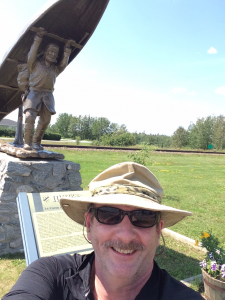
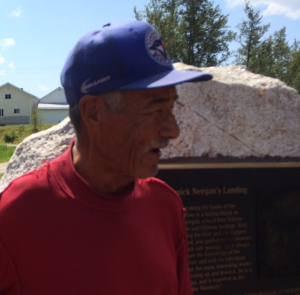 As we were preparing to launch the canoes, a man approached us on a four-wheel off-road vehicle. He’s Fred Neegan, a Cree man who has lived on the Missinaibi his whole life, having paddled up and down it many times. Now 85 years old, he’s called the “Guardian of the Missinaibi,” and there’s a monument to him, with his likeness, at the Mattice put-in. Fred warned us about the low water levels and gave us some other valuable advice about paddling to Moosonee. He also told us some of the interesting history of the river and some of the troubling aspects of being Cree in northern Ontario, even today. I asked if I could talk to him about his life story, and if I can manage it, I’d like to write the book about the Guardian of the Missinaibi.
Another story to come!