


“Authoritarianism appeals, simply, to people who cannot tolerate complexity.”

Authoritarianism is growing in popularity in many democracies, as we can see in places that were once seen as democratic success stories like Hungary and Poland. “Populist” parties and leaders in Italy, France and the U.K.
Trump’s populist and authoritarian appeal is undeniable, and terrifying as it happens in the country that proclaims itself as the beacon of democracy for the world.
This is no accident. American historian Anne Applebaum reminds us that history is cyclical, not a straight line forward all the time. Anyone who knows anything about history knows how the democracies of Rome and ancient Greece (limited and flawed as they were) eventually became oligopolies and finally authoritarian, autocratic states.
The question today is, what is the message that makes authoritarianism so appealing to some people? And what is it that makes some people respond to that message?
The message

I listened to a talk with author Anne Applebaum last night on my favourite radio program, Ideas. It’s now available as a podcast, and I highly recommend anyone who likes to think and ideas listen to it.
Her latest book is called The Twilight of Democracy, in which she discusses the history of the evolution of democracies in history, and examines the rise of authoritarian, populist strong-men in several different countries, including the U.S.
Her answer:
“I think that authoritarianism has allure for people on the right and on the left. And in fact, I’ve spent a lot of my career writing books about left-wing authoritarianism. … But I do think that we, who live in liberal democracies, have long underestimated the appeal of the one party state, of the single ruler, of the leadership cult.
“For many people, democracy is a difficult and complicated, and often unsatisfying political system. So it’s a system in which people are arguing all the time. There’s no final solution or answer. Sometimes democracies become very weak — ours in particular, I think the American democracy has been weakened by dirty money, by the influence of lobbyists. You know, democracy requires a lot of its citizens. It requires that you be involved in politics, that you join parties, that you join civic organizations, that you vote. And for a lot of people, it’s a difficult and exasperating, and even enervating form of politics.”
In short, democracy is hard. It requires a large number of citizens to participate. This means more than voting once every four years, or marching in a protest once in a while. It requires the hardest thing of all: critical thinking.
It’s so much easier to believe someone who echoes what you want to be true.
The message: “Support this strong man leader, and you’ll get what you want, and you won’t have to do the hard work of thinking about political policy. The strong man will do it all for you.”
Applebaum pointed out at one point that, historically, the cult leader, left- or right-wing, has always been a man: Hitler, Mussolini, Stalin, Julius Caesar, Augustus, Pol Pot, the list goes on.
The allure
Okay, it’s easier to follow a strong man—as long as you can be part of the dominant, favoured group. The Aryans, the Romans, the faithful Party members, the real Americans. Otherwise, you’re marginalized and subservient. A Jew, a barbarian, an immigrant. A woman, a sexual deviant. A non-believer in Truth.
Don’t like it? Tough. The dominant group has the guns, and they’re not afraid to use them.
However, in a culture that makes such a show of valuing democracy and freedom as the United States, it’s hard to understand the willingness to abandon those values and embrace the vesting of arbitrary, total power in one man.
Applebaum looked at people she knew who had made that political and philosophical journey. “Usually the connecting theme is some kind of radical disappointment. In a couple of cases, it’s personal disappointment.”
There is also fear. Applebaum uses Fox “News” personality Laura Ingraham who rants very loudly about the changes in American society. Applebaum claims that American society is more secular than it was (I don’t know whether I agree with that), which Ingraham equates with moral decline.
Demographic shift is also seen by many as a threat. This is behind the familiar “I want my country back” and “good old days,” and especially “Make America great again” messages.
“It’s partly an imagined past. It’s partly an idealized past. It’s partly based on a particular reading of history. In America, it’s about white picket fences in small towns — a picture that, you know, excludes what Black Americans were doing at that time, or doesn’t have a role for women, for example, of a kind that they play today,” Applebaum says.
Anger and fear

This is my take-away from Applebaum’s talk. The message is that the strong-man will restore the society, the world that you want, and that you imagine used to exist. When people who scare you because they’re different from you (difference you’ve been taught to fear by people who want to use that fear to empower and enrich themselves).
It’s fear of change. Fear of losing something important to you to someone who’s different.
That fear is based on false premises, and it is a powerful resource to people who know how to exploit it.
The authoritarians, the strong-man’s backers, knowingly and willingly exaggerate this fear. Take, for example, Trump’s statements about the threats to suburbs, for example, and his characterization of Black Lives Matter protesters as “looters” and antifa protestors as radical left revolutionaries.
We have plenty of parallels in Canada, too. Criminalization of Indigenous protestors, for one. Calling political opponents traitors and criminals, another.
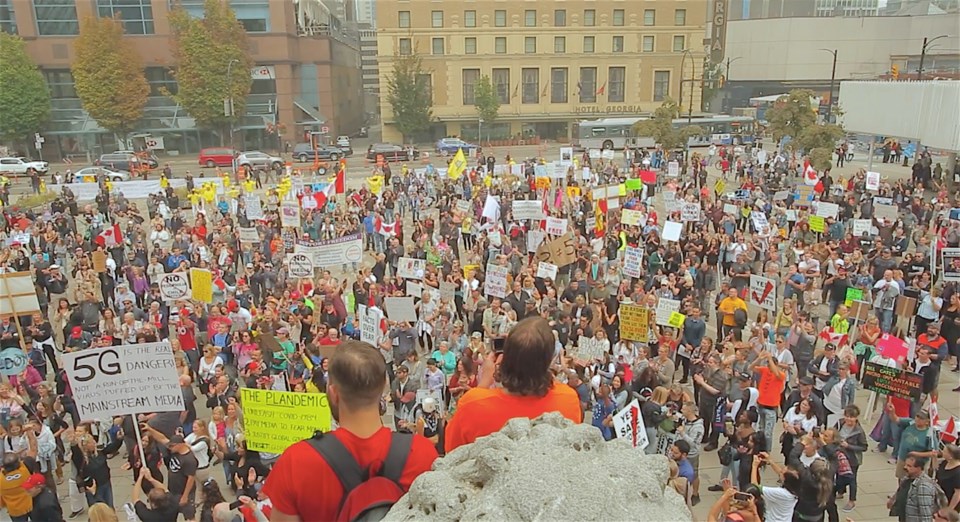
Describing wearing masks to protect others against infection as infringement of civil rights. Or vaccination of children as oppression.
The backers of the strong man stoke the fear into anger, into rage and encourage violence against their opponents. Then blame the violence on the victims.
It has happened before. It is happening now. All around the world.
If we still value democracy, liberty and human rights, we have to get away from fear and anger and turn to rationality.