


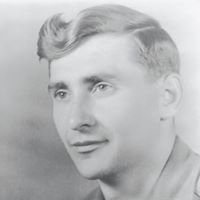
 I have been stuck for quite a long time in the writing of the third installment of the trilogy based on my father-in-law’s life, Walking Out of War.
Until I pulled a little slip of paper out of a tattered, old wallet and broke the logjam by putting the subject of my story, Maurice Bury, into a real time and place.
Writing this trilogy that began with has taken a lot of research. I don’t want to begin estimating the number of hours, but literally, the effort has spanned more than
10 years.
It began with Maurice’s stories about the war. Then, we sat down to serious interviews, where I took extensive notes.
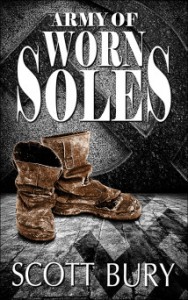
His wartime experience fell into three phases, the first two of which I have already published in Army of Worn Soles and Under the Nazi Heel.

The third part, Walking Out of War, covers Maurice’s experience as a private in the Red Army from 1944 to 1945. And while I still had those interview notes, Maurice passed away 12 years ago, so I cannot ask him about questions that come up only when you try to write a story like this.
So I had to turn to historical records. Thank you, Wikipedia and Professor Orest Subtelny.
Bringing the story to life
Anyone who has tried to tell an accurate story about the Second World War can tell you how confusing it can be, with many different forces acting in several
different theatres of war at the same time.
I used a range of sources, including some of Maurice’s personal effects. They included a tattered, battered old wallet containing some fascinating documents:
 Allied Expeditionary Force D.P. Index cards, signed by Maurice in Cyrillic script
- a notarized affidavit from Maurice’s aunt in Montreal, mentioning Maurice as a Canadian citizen living in a United Nations Relief and Rehabilitation Administration Displaced Persons camp in Landeck, Austria
- Allied Travel permits authorizing Maurice to go from Landeck to Vienna in early 1947.
These and other documents supported Maurice’s story and my notes about going from Berlin to Ingolstadt, Bavaria, and then Landeck, Innsbruck and finally Vienna before coming home to Canada.
But I was still having trouble getting Maurice’s journey clear in my own mind.
The final clue
 Months later, I saw a thin pocket in the old wallet that I had never noticed before. From it, I pulled out a thin slip of yellowed paper. Typed with an uneven manual
typewriter was the following:
Recen. Co. 692 T.D.Bn.
July 7, 1945.
To whom it may concerns:
The following two men, Maurice Bury, and Tkacz
Bazyli , have been working for us as K. P.s for the last
xxxxx month, and we have found there work to be very
satisfactory.
We recommend them very highly.
signed,
John Gardner
1st Lt. W.A.
commanding
I was very excited. I showed it to a retired Canadian Armed Forces general, who explained some of the abbreviations at the top. “T.D.Bn” stands for “tank destroyer battalion.” And the reference to “K.P.” indicated an American unit.
Maurice had told me that, following the war, he had worked for the American Army, first helping out in the kitchen and then as a translator—he spoke English, German and Russian as well as Ukrainian.
A Google search for the 692nd Tank Destroyer Battalion told me that it indeed had been formed in 1942, arriving in France in September 1944. It was attached to the 104th Infantry Division, and then to the First Canadian Army, which it supported in its attack on Antwerp, Belgium and the crossing of the Maas River. The 692nd repelled the Germans in the Battle of the Bulge, and in February 1945 its accurate artillery fire preserved the Regamen Bridge over the Rhine, allowing the Canadian troops to cross, saving lives. It was also the only unit called upon to break the Siegfried line more than once.
This was the unit that liberated the Dachau concentration camp.
At the end of the war, the 692nd took on occupation duties in an area around the Bavarian-Austrian border.
At last, I had corroborating evidence putting Maurice Bury in southern Germany on a specific date shortly after the end of the war: July 7, 1945. It gave me two other names, as well: Lt. John Gardner, commanding officer of the 692nd on that day; and “Tkacz Bazyli.”
That’s just one of the mistakes in the letter. You’ll notice the other typos, too. “Tkacz” is a Ukrainian surname, and Maurice was friends with a man named Basil Tkacz in Montreal.
Why is this important?
This little slip of paper helped me put the end of Maurice journey out of the war into order.
This little slip of paper makes an anchor. He was in southern Germany, or maybe norther Austria, on July 7, 1945.
It gave me a timeline.
And that has allowed me to finish writing the story.
I know that I promised to release Walking Out of War before the end of 2016, and I’m sad to say that I won’t be able to do that.
I have written the draft and completed the re-write, adding all the little details. But now the manuscript has to go to an editor, a proofreader and some beta readers. It will also need a cover design before I format it and publish it as an e-book and a print book.
But know that it is imminent. All the pieces are in place, anchored with historical detail. So don’t despair, readers. The final installment of the trilogy will be in your hands soon.
Permalink
Very, very cool, Scott! It just shows it pays to keep at it! Nicely done!